By: Ely Bushman

St. Catherine University – Photo Credit: Office of Admission
At St. Catherine University, a STEM classroom would look like any normal school classroom. Chairs and tables for students, an area for a professor to lecture, and some kind projector for presentations. However, there is one significant difference in St. Catherine’s STEM classrooms, there are no male students in sight.
Professor Cynthia Norton considers this an advantage for St. Catherine University. Norton has been a professor at St. Catherine since 1990, and her primary field is biology and women’s studies.
“I really didn’t inte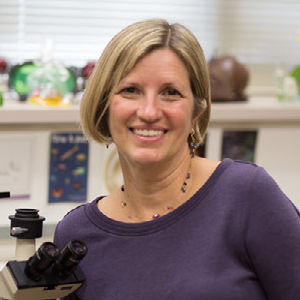 nd to be an educator when I began my career. I was simply interested in science, and was curious about the natural world,” Norton Said.
Norton graduated from a women’s college, and she “specifically chose St. Kate’s because it is a women’s college.”
Dr. Cynthia Norton – Photo Credit: St. Catherine’s faculty web-page
Norton believes that all women’s colleges like St. Catherine gives an advantage to women pursuing STEM. “Women from all-woman institutions are more likely to go on to graduate study and earn PhDs (in STEM as well), they are more likely than women at co-ed institutions to actively participate in class discussions and activities, and be leaders on campus. Women’s colleges also tend to have higher numbers of female faculty members so students see and work with women scientists as role models,” Norton said.
It is no secret that women pursuing STEM face their own set of unique challenges. One specific challenge that Norton highlights is the “imposter syndrome.” Norton says that the effect of the syndrome gives women the feeling that they have “succeeded by luck” rather than their own ability. This is “very common not only in young women, but also in highly successful women,” Norton said.
Another challenge women in STEM face is “inclusion.” Norton said that this is now a “national conversation,” and that “there is increasing recognition that women and people of color in general are still under-represented in many scientific fields.” Also, Norton said “science will be improved by including the perspectives and experiences of our increasingly diverse population.”
When asked how specifically St. Catherine approaches all women’s science, Norton said, “we are focused on classroom, laboratory, and field experiences that are inclusive and empowering to women. We not only prepare our students with the skills and information they will need to succeed, but we care about their development as scientists. We strive to present information in a variety of ways, actively involve students in classroom activities, and help them develop as critical thinkers and writers. We intentionally highlight the contributions of women and people of color in science, and we make a conscious effort to connect science to social issue and to their lives.”
Another advantage that is unique to St. Catherine is the “opportunity students have to engage in research,” Norton said. “They write research proposals, design experiments, collect and analyze data, and present their work at a poster session at the end of the semester.” While this may not sound like unique activities in a classroom “it is unusual to do this in an introductory course.” This allows for an early fundamental development of “skills that will prepare them well for their professional lives,” Norton said.
With all of the advantages and unique activities St. Catherine’s science department has to offer, Norton “would really like to see more students coming to St. Kate’s to major in STEM fields.” She also wishes that finances didn’t put as much of a burden on students. “It is difficult to put in the time necessary to succeed when our students are working so hard to afford their studies.” Also, “I would like to see more students working in the department as these work study experiences give them important skills as well as relationships with faculty, staff, and other students,” Norton said.

