By: Emma Hamilton
The representation of women and diversity in science has recently been under scrutiny. At Hamline University these women share their experience.
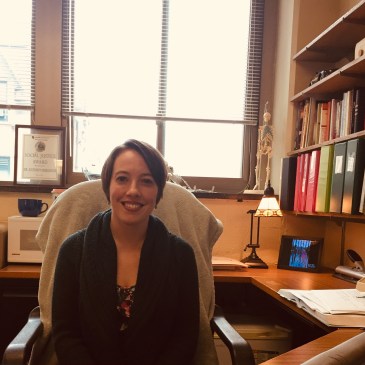
Like many biologists, Dr. Kathryn Burleson, a professor at Hamline University explained that when she first started “I wanted to be a doctor.” But that she didn’t want to separate her feelings from her work “I decided that being a doctor would be a really emotional a job. I didn’t want a career where I had to set aside my emotions.”
After attaining her BA, MS and eventually her Ph.D. teaching just fell in her lap.
She commented that “[teaching biology] was probably what I was meant to do I just didn’t realize it.”
Irina Makarevitch Professor, Department Chair of Biology and the Director of the Exercise Science Program at Hamline University, explores a similar journey starting her careerI in science saying, “My mom wanted me to be a doctor. So for a while, I was like, Okay, I’m going to be a good girl. I’m going to be a doctor.”
/Images/professor-irina-makarevitch-2014.jpg?n=7698)
Makarevitch grew up in Novosibirsk Russia and explained that the inspiration for her imigration to America was because “Well, I was growing up in the period where the Soviet Union dissolved. The 90s were kind of hard times for science” she further elaborated that there was virtually no funding for science, research, and salaries.
Utilizing her family ties in America Makarevitch cam to Minnesota because of her great-grandmother who lived here.
However, like Burleson, she too was drawn to teaching. After working in a lab and excelling among her male peers Makarevitch turned down a research position in a lab to work in an educational setting. “I said, ‘No, I’m not going to go.’ And he asked ‘why?’ And I said, ‘because I want to teach.’ He looked at me like I was like, completely crazy” Makarevitch said. She explained that teaching was natural to her and something she had been doing even as a young child.
Burleson found herself involved in many female-focused organizations, one of them being the American Association of University Woman (AAUW). “Form my first year of graduate school, all the way up till 2016 I was involved in [the AAUW] in every level.” She stated, recounting her participation in the process of giving grants to women from all kinds of different backgrounds, looking to further their education in degree, certificate, or research.
Burleson has dedicated her time to diversifying the biology department saying that “A lot of my work now is a little bit more intersectional [than just focusing on gender] because that’s where we need to be growing.”
She has published research in the areas of Ovarian Carcinoma, as well as microbes in mascara. Burleson uses the microbes in mascara research as a lab with her students. She Explained that it is not just about mascara but that “That lab, in particular, is looking at how our cosmetic products get contaminated with fungus and mold and bacteria and things.” She commented on it saying that students contact her years later, still thinking about their scientific findings.
In biology, Burleson has never felt discriminated against based on gender
“I think I work in a department that is very supportive”
Burleson
She commented that from her own informal observation, women in biology are well represented. At Hamline University, technically “increasing diversity would be hiring more men” said Burleson.
Makarevitch spoke about her experience saying that “In Russia, it was slightly different. I think it was a lot more equitable. Like this whole idea that women are meant to stay at home, and never work, was never really a value of Russians. Primarily, because there would never be enough money… So like, Women had to work to make money.”
“I have a very strong will, so if anyone told me [that I can’t do science] that would be a problem for them really really quickly.” Said Makarevitch
Both Burleson and Makarevitch reflected on biology as a whole, and the ratio of women to men.
“If you look at things like physics and other sciences, those tend to have more men. I believe biology as a science field draws more women. It’s a trend I have seen at a lot of places” Said Burselson.
In reference to women in other departments in other fields Burleson said, “I definitely know women who’ve had experiences – and not necessarily here, but in chemistry or physics or in departments where it’s been primarily men – where they do feel kind of ostracized.”
Makarevitch has also noticed the overwhelming amount of women in biology commenting that “Our students are also very female. I think 70 to 75 percent of students are female.”
Although both women cannot recall feeling discriminated against, they have noticed traits of their female students and colleges that seem simtamatic of lingering gender divides in science.
One characteristic Makarevitch noticed was that
“In general, women are more likely to take a job if they like it, even if it’s a little bit less money.”
Makarevitch
Burleson commented that “Imposter phenomenon seems a bit more gendered. A lot of women I talk to, doubt themselves”
When recounting a particularly challenging semester early in her carer at St. Thomas Burleson described “[One] spring, I was teaching standalone classes. And that was really hard because I had just had my second baby. So I was pregnant when I started that job and had him in January. And classes started 10 days after he was born… I went to school with a newborn every day. Students would watch him in my office when I went to class.”
Burleson wants young women of science to know that “they aren’t alone, that they are capable of doing these things, that they shouldn’t be afraid of trying.” and “You still have so much learning and growing you can do.”
Makarevitch says that it is essential for students to find where their passion lies. “I think students should find what they are excited about and spend time exploring that. You have to find a deep interest in something, and then you have to pursue it, and it doesn’t matter what other people say. You can do it!”
 Women of Science